Movement No. 60 presents an elegant two-speed transmission system that uses two drive belts and a carefully arranged set of four pulleys to select between two distinct output speeds on the lower shaft — without any gears, clutches, or complex mechanisms. The lower output shaft carries four pulleys mounted side by side. The two outer pulleys are loose — they spin freely on the shaft and transmit no motion to it. The two inner pulleys are fast — they are keyed or fixed to the shaft and rotate with it as a rigid unit. Two drive belts connect the upper driving shaft to the lower output shaft — each belt running over one upper pulley and one of the lower four. The upper pulleys are of different diameters, giving each belt a different speed ratio when engaged. The speed selection works by shifting both belts simultaneously. In the first state — slow speed — the right-hand belt rides on its fast (inner) lower pulley, driving the shaft, while the left-hand belt rides on its loose (outer) lower pulley, freewheeling without driving. Only the right belt is actively transmitting, and the pulley-size ratio it engages produces the slower output speed. To switch to fast speed, both belts are shifted simultaneously: the right belt moves to its loose outer pulley (disengaging), and the left belt moves to its fast inner pulley (engaging). Now the left belt drives the shaft through a different pulley ratio, producing the faster output speed. This two-belt, four-pulley arrangement cleverly ensures that exactly one belt is always driving while the other freewheels — providing a seamless, continuous speed selection without interrupting the drive. The mechanism is a direct application of the fast-and-loose pulley principle that was fundamental to 19th-century mill and factory line-shaft systems.
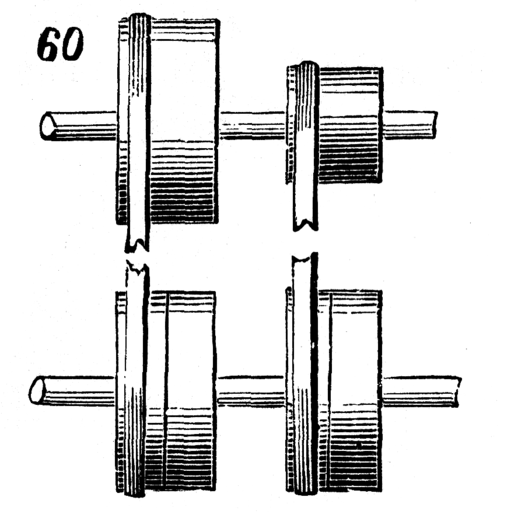
60. For transmitting two speeds by means of belts. There are four pulleys on the lower shaft, the two outer ones being loose and the two inner ones fast. The band to the left is shown on its loose pulley, the one to the right on its fast one; a slow motion is consequently transmitted to lower shaft. When band to the right is moved on to its loose pulley, and left-hand one on to its fast pulley, a quicker motion is transmitted.