Movement No. 57 presents one of the most mechanically complex and visually spectacular mechanisms in the early sections of the 507 collection — a belt-driven system of two concentric gears driving an intermediate planetary pinion in a compound orbital motion. The driver is a small pulley at the top, which sends drive to the system via two belts or bands. These bands connect to the large internally-toothed ring gear and to a smaller concentric spur gear positioned inside it — both centered on the same axis. Crucially, the two bands are arranged so that the ring gear and the inner concentric gear are driven in opposite directions simultaneously — one clockwise and the other counterclockwise — by the single driving pulley. Between these two counter-rotating concentric gears sits an intermediate pinion at the bottom, meshing with both the inner surface of the ring gear and the outer surface of the inner concentric gear simultaneously. Because the two gears surrounding this pinion rotate in opposite directions, the pinion is driven to rotate about its own center axis — spinning on its own. But because the pinion is constrained between the two concentric gears and both are rotating, the pinion also undergoes orbital motion — revolving around the common center of the two concentric gears. The result is a compound planetary motion: the pinion simultaneously spins on its own axis and orbits around the central axis — a motion with characteristics directly related to early epicyclic and planetary gear theory. This combination of belt drive, internal gearing, and planetary motion makes Movement No. 57 one of the most intellectually rich mechanisms in the entire collection.
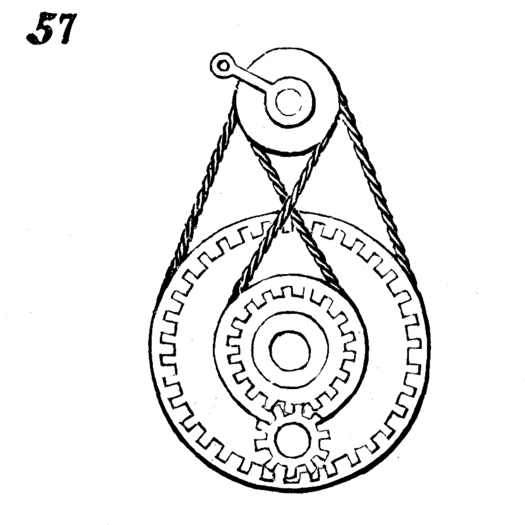
57. The small pulley at the top being the driver, the large, internally-toothed gear and the concentric gear within will be driven in opposite directions by the bands, and at the same time will impart motion to the intermediate pinion at the bottom, both around its own center and also around the common center of the two concentric gears.