Movement No. 55 presents a deceptively simple yet conceptually rich gear arrangement: a single pinion B simultaneously driving two gears, A and C, which are mounted on the same shaft — but rotating at different speeds relative to each other. At first glance, this seems paradoxical — how can two gears on the same shaft rotate at different speeds? The answer lies in the fact that gears A and C are of different diameters and different tooth counts, while both mesh with the same driving pinion B. Because the speed ratio between a gear and its driving pinion is determined by the ratio of their tooth counts, gear A — having a different number of teeth from gear C — will be driven at a different angular velocity than gear C, even though the same pinion B drives both simultaneously. For this to work, gears A and C must be mounted loosely on the shared shaft — free to rotate independently — rather than being keyed to it. The shaft itself may then be driven by one of the gears through a selective clutch or other mechanism, or the arrangement may serve as the basis for a differential or compound gear train. This mechanism elegantly demonstrates that two gears can coexist on the same shaft axis while rotating at entirely different speeds, and that a single pinion can serve as the simultaneous driver for multiple gears of different ratios. This principle is fundamental to the design of compound gear trains, back-gear mechanisms in lathes, and multi-speed transmission stages found throughout mechanical engineering.
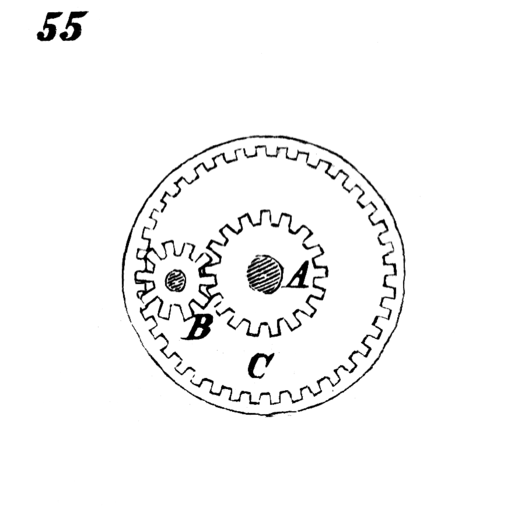
55. Different velocity given to two gears, A and C, on the same shaft, by the pinion, B.