Movement No. 52 presents yet another variation of the clutch-box — a simple yet effective positive engagement clutch that uses protruding studs and corresponding holes to lock two rotating disk-wheels together as a single unit. The mechanism consists of two disk-wheels mounted on the same shaft axis, facing each other. One disk carries a set of studs — cylindrical pins projecting axially from its face. The other disk has a matching set of holes positioned at exactly the same radial distance and angular spacing as the studs on the first disk. When the two disks are pressed axially together, the studs on the first disk enter and seat into the holes of the second disk. Once engaged, the studs physically interlock with the holes, creating a rigid positive connection — the two disks are now mechanically locked together and rotate as one, transmitting full torque between them with no slippage whatsoever. When the disks are pulled apart axially, the studs withdraw from the holes and the two disks are free to rotate independently. Compared to the frictional clutch-box of Movement No. 47 and the jaw clutch of Movement No. 48, the stud-and-hole clutch of No. 52 offers a particularly simple and clean positive engagement mechanism — the circular studs and round holes are easy to manufacture with high precision, and the engagement is self-centering as the tapered or rounded stud tips guide themselves into the holes. Like all positive engagement clutches, this design must be engaged carefully when both disks are at the same rotational speed, as engaging under speed mismatch would cause the studs to strike the face of the opposing disk rather than entering the holes cleanly.
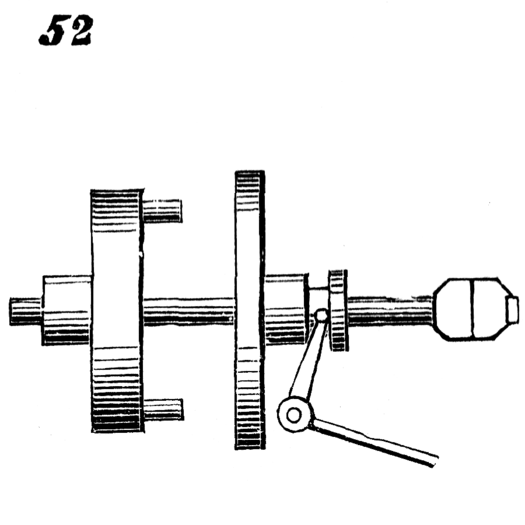
52. Another kind of clutch-box. The disk-wheel to the right has two holes, corresponding to the studs fixed in the other disk; and, being pressed against it, the studs enter the holes, when the two disks rotate together.