Movement No. 45 presents a mechanism described by Henry T. Brown as a comparatively recent invention at the time of publication — frictional grooved gearing. This innovative transmission system bridges the conceptual gap between conventional smooth friction wheels (like those of Movement No. 32) and conventional toothed gears (like Movement No. 24), combining elements of both into a hybrid mechanism with unique advantages. Unlike ordinary friction wheels, which transmit power solely through the frictional force between two smooth cylindrical surfaces pressed against each other, frictional grooved gearing features interlocking grooves and ridges machined into the contact surfaces of both wheels. These grooves and ridges mesh together like shallow teeth, greatly increasing the surface area in contact and therefore dramatically increasing the total friction force available for power transmission — without requiring the wheels to be pressed together with extremely high forces. The grooved profile also provides a degree of positive engagement beyond pure friction: the interlocking geometry of the grooves physically prevents the wheels from slipping relative to each other in the same way that flat friction surfaces would under high load. At the same time, unlike rigid gear teeth which can break under overload, the grooved friction surfaces can still slip and slip smoothly if the transmitted force exceeds the design limit, providing natural overload protection. The enlarged cross-section diagram included in the original illustration makes the interlocking groove geometry clearly visible, showing how the ridges of one wheel nest into the grooves of the other. This mechanism represents a thoughtful engineering hybrid — quieter and more overload-tolerant than toothed gears, yet more positive and higher-capacity than plain friction wheels.
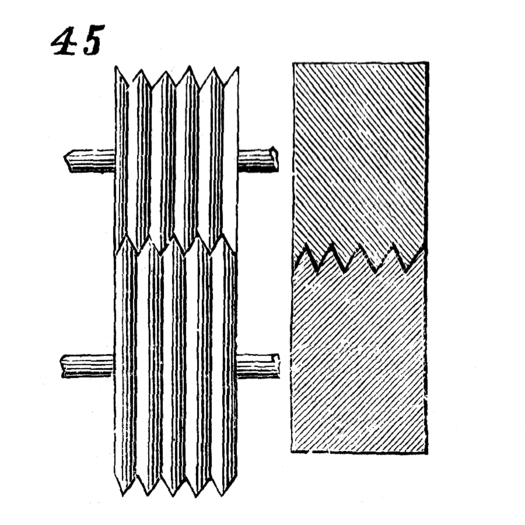
45. Frictional grooved gearing-a comparatively recent invention. The diagram to the right is an enlarged section, which can be more easily understood.