Movement No. 34 introduces the internally toothed spur gear — also known as the ring gear or annular gear — paired with a smaller pinion gear that meshes on its inside surface. This is a direct and illuminating contrast to Movement No. 24, which presented the conventional external spur gear pair. In an external gear pair (No. 24), the teeth of two gears face outward from each other, and the two gears necessarily rotate in opposite directions. In Movement No. 34, the teeth of the larger gear face inward — pointing toward the center of the ring — and the smaller pinion meshes inside the ring, running along the internal tooth surface. This internal engagement produces two immediately important differences from the external configuration. First, both the ring gear and the pinion rotate in the same direction — unlike external gears where the driver and driven always turn opposite to each other. This same-direction rotation is highly valuable in compact transmission designs where preserving the sense of rotation through a gear stage is important. Second, and critically from a strength and reliability standpoint, more teeth are simultaneously in contact between the pinion and the internal ring than would be the case in an equivalent external gear mesh — meaning for the same tooth strength, the internal gear pair can transmit significantly greater force without tooth failure. The internal ring gear and pinion is a foundational component of planetary gear systems, automatic transmissions, epicyclic gear trains, and many compact, high-torque drive systems used in modern automotive, aerospace, and industrial applications.
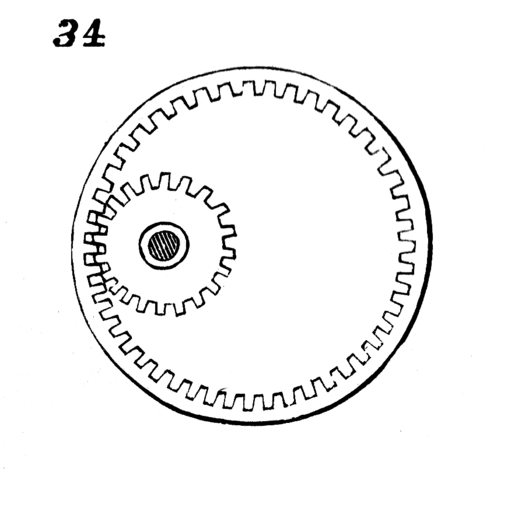
34. An internally toothed spur-gear and pinion. With ordinary spur-gears (such as represented in 24) the direction of rotation is opposite; but with the internally toothed gear, the two rotate in the same direction; and with the same strength of tooth the gears are capable of transmitting greater force, because more teeth are engaged.