The worm gear — also known as the endless screw — is one of the most widely used and elegant mechanisms for transmitting rotational motion between non-intersecting, perpendicular shafts. It consists of two key components: the worm, a helical screw-like shaft that acts as the driver, and the worm wheel (or worm gear), a toothed wheel whose teeth mesh continuously with the threads of the worm. As the worm rotates, its helical thread pushes against the teeth of the worm wheel, causing it to turn at a significantly reduced speed. This arrangement provides a very high gear reduction ratio in a compact space — a feature that makes it extremely practical for machinery. One of its most notable characteristics is self-locking: in many configurations, the worm wheel cannot back-drive the worm, meaning the system naturally holds its position under load without additional braking mechanisms. The worm gear was considered easier to manufacture than equivalent mechanisms such as crossed helical gears, which is why Henry T. Brown noted it is “oftener used.” Today, worm gears are found in elevators, conveyor systems, guitar tuning machines, and steering mechanisms.
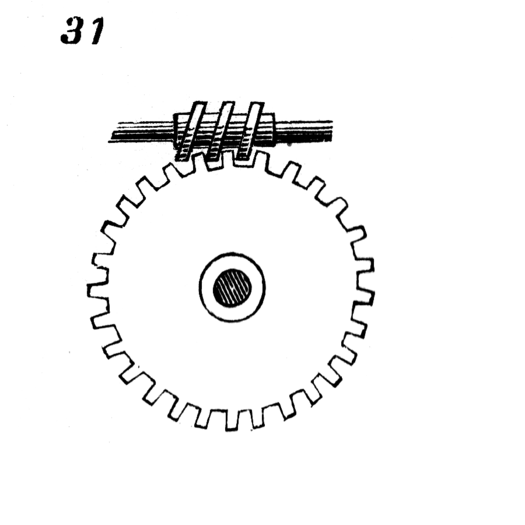
31. Worm or endless screw and a worm-wheel. This effects the same result as 29; and as it is more easily constructed, it is oftener used.