Movement No. 29 demonstrates a clever method of transmitting rotary motion between two shafts oriented at right angles to each other. The mechanism consists of a flat disk-wheel engraved with a single continuous spiral thread on its face, paired with a spur gear whose teeth mesh with that spiral. As the disk-wheel completes one full revolution, the spiral thread engages the teeth of the spur gear one by one, advancing it by exactly one tooth per revolution of the disk. This creates an extremely high gear reduction ratio — the output spur gear moves only one tooth for every complete rotation of the driver disk. The mechanism is an early and inventive precursor to modern face worm gearing, translating smooth continuous rotation of the disk into a slow, precise, and controlled rotation of the spur gear on a perpendicular axis. Its compactness and high reduction ratio made it particularly attractive for applications in instrumentation and precision machinery where controlled, slow-speed output was essential.
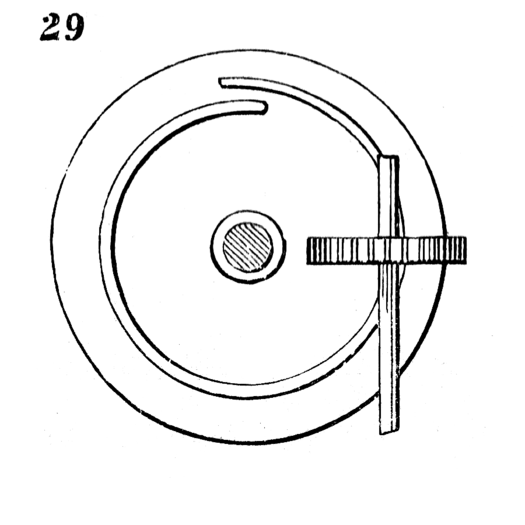
29. Transmission of rotary motion from one shaft at right angles to another. The spiral thread of the disk-wheel drives the spur-gear, moving it the distance of one tooth at every revolution.