Movement No. 28 features a mechanism historically known as “brush-wheels” — an elegantly simple form of continuously variable friction drive. The mechanism consists of two wheels: a large flat horizontal disk (the lower driver wheel) and a smaller wheel oriented perpendicularly on a vertical or angled axis (the upper driven wheel), whose rim rests on the face of the lower disk. Power is transmitted entirely through friction and surface adhesion between the two wheels — no teeth, no belts, no interlocking parts. The key feature of this mechanism is its ability to provide continuously variable speed: by sliding the upper wheel radially across the face of the lower disk — moving it closer to or farther from the center — the effective drive radius changes, and therefore the output speed changes proportionally. When the upper wheel is positioned near the center of the disk, its speed is low; as it moves outward toward the rim, its speed increases. Traction can be improved by facing the lower disk with vulcanized india-rubber, increasing the coefficient of friction between the contact surfaces. This mechanism is a direct forerunner of the modern continuously variable transmission (CVT).
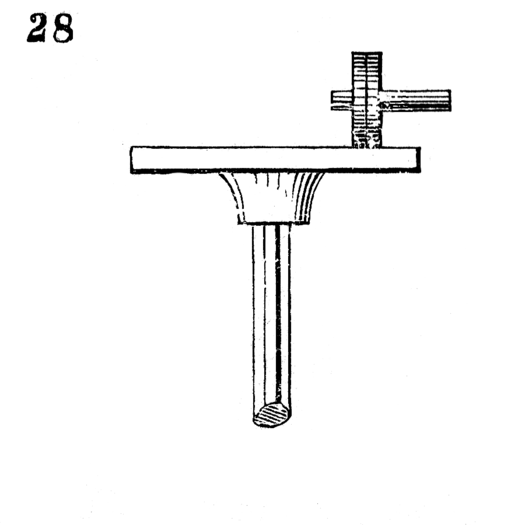
28. These are sometimes called "brush-wheels." The relative speeds can be varied by changing the distance of the upper wheel from the center of the lower one. The one drives the other by the friction or adhesion, and this may be increased by facing the lower one with india-rubber.