Movement No. 26 introduces the crown wheel — a distinctive type of gear whose teeth project axially from a flat or slightly dished disk face, rather than radially from a cylindrical surface as in conventional spur gears. When paired with a standard spur gear, the crown wheel transmits rotational motion between two shafts oriented at right angles to one another, similar in function to a bevel gear arrangement, but with a markedly different geometry. The teeth of the crown wheel are cut perpendicular to the disk face and project outward like the points of a crown — hence its name. The meshing spur gear engages these teeth along their length as the two wheels rotate together. However, this arrangement has a significant structural limitation: the teeth of the crown wheel must necessarily be made thin and delicate due to the geometry of the disk face, which severely restricts the load they can carry. As a result, crown wheel and spur gear combinations are only suited for light-duty applications with low transmitted forces, and they are rarely used in modern heavy machinery. Historically, crown wheels appeared in early clock movements and simple mill mechanisms where loads were modest and their unique right-angle drive geometry was advantageous.
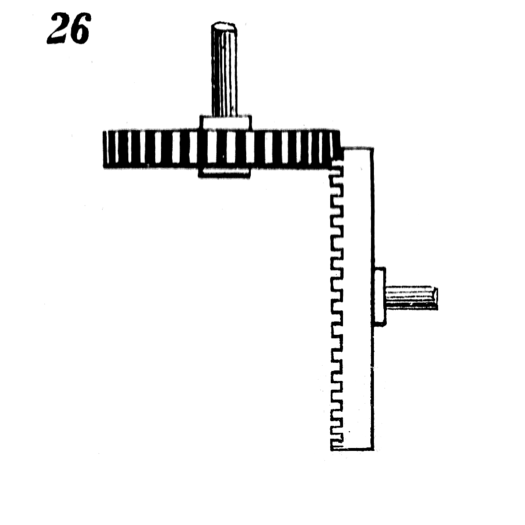
26. The wheel to the right is termed a "crown-wheel;" that gearing with it is a spur-gear. These wheels are not much used, and are only available for light work, as the teeth of the crown-wheel must necessarily be thin.