Movement No. 24 presents the spur gear — the most fundamental and universally recognized gear type in all of mechanical engineering. A spur gear is a cylindrical gear with teeth cut parallel to the axis of rotation, projecting radially outward from the gear’s surface. When two spur gears of different sizes mesh together, they transmit rotational motion between two parallel shafts, simultaneously changing both the speed and torque of the output relative to the input. The gear ratio is determined simply by the ratio of the number of teeth on each gear: the larger gear (with more teeth) rotates more slowly but produces greater torque, while the smaller gear (with fewer teeth), known as the pinion, rotates faster but with less torque. The direction of rotation is always reversed between the driver and driven gear in an external spur gear pair — if the driver rotates clockwise, the driven gear rotates counter-clockwise. Spur gears are characterized by their simplicity, reliability, ease of manufacture, and high efficiency. Because their teeth engage along a line parallel to the shaft axis, they generate no axial thrust forces, simplifying bearing design. However, this same geometry means that teeth engage and disengage abruptly, which can produce noise and vibration at high speeds. Despite this limitation, spur gears remain the most widely used gear type across industries — from clocks and household appliances to industrial machinery and automotive transmissions.
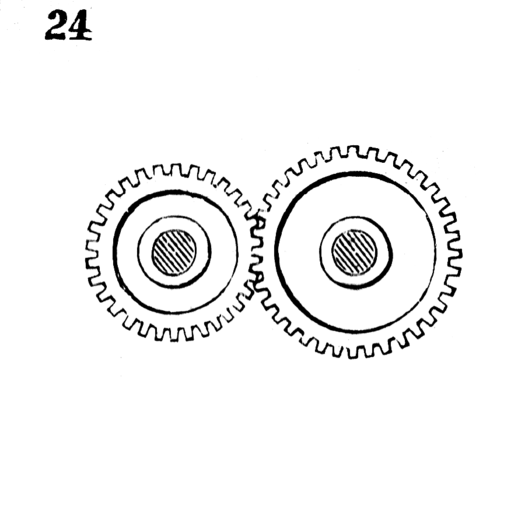
24. Spur-gears.