Movement No. 23 presents an elegant engineering solution to a classic problem in belt-drive systems: how to maintain constant belt tension when the driven pulley is free to move. The central challenge is that when a pulley is mounted on a movable carriage — one that can be raised or lowered — any change in its position will directly alter the effective length of the belt path, causing the belt to either go slack or become over-tensioned. Left unaddressed, this would cause slipping, reduced power transmission efficiency, or even belt failure. The mechanism solves this problem automatically through a counterbalance system. A tension pulley, A, is mounted in a sliding frame that moves freely between vertical guides. This pulley is connected by a rope that passes over two fixed guide-pulleys, B and B, to a balance weight, C. The weight of C constantly pulls pulley A downward, maintaining a continuous and uniform tension on the belt at all times regardless of the position of the movable driven pulley. As the driven pulley rises or falls, pulley A adjusts its position automatically to compensate, keeping the belt taut and the tension consistent throughout the system. This mechanism is a direct ancestor of the modern automatic belt tensioner used in automotive engines and industrial conveyor systems.
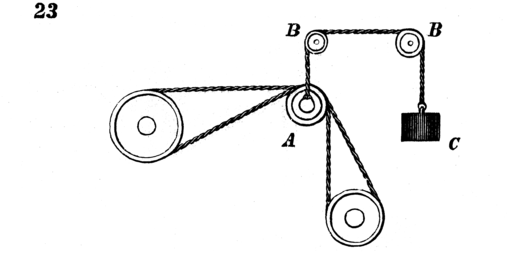
23. A contrivance for transmitting rotary motion to a movable pulley. The pulley at the bottom of the figure is the movable one; if this pulley were raised or depressed, the belt would be slackened or tightened accordingly. In order to keep a uniform tension on the belt, a pulley, A, carried in a frame sliding between guides (not shown), hangs from a rope passing over the two guide-pulleys, B, B, and is acted upon by the balance weight, C, in such manner as to produce the desired result.