Movement No. 22 is the most elaborate of a series of pulley arrangements (Movements 19 through 22) that demonstrate the principle of mechanical advantage through compound pulley systems. In this class of mechanism, each movable pulley is embraced by its own dedicated cord — one end of which is fixed to a stationary point, and the other end attached to the axle of the next pulley in the chain. This arrangement is fundamentally different from a simple block-and-tackle system where a single continuous rope threads through multiple sheaves. Instead, each pulley in this system acts as an independent force multiplier. The governing rule is elegantly mathematical: the mechanical advantage of the entire system equals 2 raised to the power of the number of movable pulleys. With one movable pulley, the mechanical advantage is 2 (the load requires only half the effort to lift). With two movable pulleys, it becomes 4. With three, it becomes 8 — and so on, doubling with every additional pulley added to the system. Movement No. 22, featuring the greatest number of movable pulleys in the series, therefore provides the highest mechanical advantage, allowing very heavy loads to be lifted with a comparatively small applied force. The trade-off, as dictated by the conservation of energy, is that the rope must be pulled through a proportionally greater distance. This principle underpins the design of block-and-tackle hoisting systems, cranes, and sailing rigging used throughout industrial and maritime history.
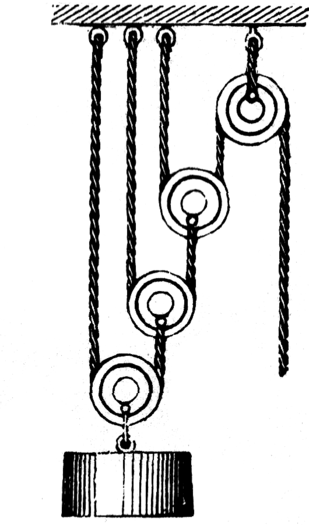
19, 20, 21 and 22. Are different arrangements of pulleys. The following rule applies to these pulleys:-In a system of pulleys where each pulley is embraced by a cord attached at one end to a fixed point and at the other to the center of the movable pulley, the effect of the whole will be = the number 2, multiplied by itself as many times as there are movable pulleys in the system.