Movement No. 21 is the third in a series of increasingly powerful pulley arrangements (Movements 19 through 22), each adding one more movable pulley to progressively multiply mechanical advantage. In this system, three movable pulleys are arranged in sequence — each one embraced by its own individual cord. One end of each cord is anchored to a fixed point on the support structure, while the other end connects to the axle of the next pulley in the chain, ultimately supporting the load below. The mathematical rule governing this entire series is elegant and powerful: the mechanical advantage equals 2 raised to the power of the number of movable pulleys in the system. With three movable pulleys in Movement No. 21, the mechanical advantage is 2³ = 8, meaning that a force of just 1 unit applied to the free end of the rope is capable of lifting a load of 8 units. Conversely, the rope must be pulled through a distance eight times greater than the distance the load is raised — a perfect illustration of the universal principle that machines cannot create energy, only redistribute it between force and distance. Each additional pulley in the chain doubles the mechanical advantage while halving the required input force, making this a powerful and scalable lifting mechanism. This fundamental principle of compound pulley systems forms the theoretical basis for modern crane hoisting mechanisms, block-and-tackle systems on sailing ships, and heavy-load lifting equipment used in construction and industry.
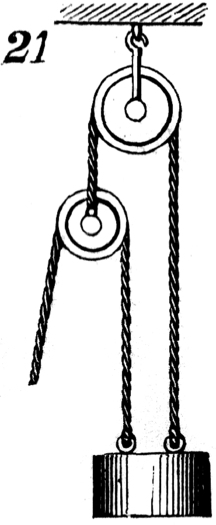
19, 20, 21 and 22. Are different arrangements of pulleys. The following rule applies to these pulleys:-In a system of pulleys where each pulley is embraced by a cord attached at one end to a fixed point and at the other to the center of the movable pulley, the effect of the whole will be = the number 2, multiplied by itself as many times as there are movable pulleys in the system.