Movement No. 19 introduces the foundational building block of a remarkable series of pulley systems (Movements 19 through 22) — the single movable pulley with an individual cord. This is the simplest configuration in the series, yet it already demonstrates one of the most powerful concepts in classical mechanics: mechanical advantage. The mechanism consists of one movable pulley whose axle is attached to the load. A single cord wraps around the pulley — one end is anchored firmly to a fixed point on the overhead support structure, while the other end is the free end to which the operator applies an upward pulling force. Because the load is supported by two segments of cord simultaneously — the fixed side and the effort side — the tension in each cord segment is equal, and together they share the weight of the load. This means the operator only needs to apply a force equal to half the weight of the load to lift it, giving a mechanical advantage of 2¹ = 2. The price paid is distance: the effort rope must be pulled upward twice as far as the load rises. This elegant and simple mechanism is the starting point for understanding the entire compound pulley series that follows in Movements 20, 21 and 22, where each additional movable pulley doubles the mechanical advantage further. The single movable pulley is one of humanity’s oldest and most enduring simple machines, with applications ranging from ancient construction techniques to modern sailing rigging and workshop hoists.
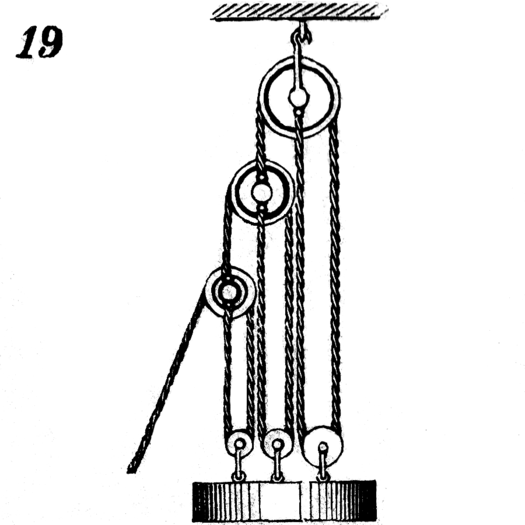
19, 20, 21 and 22. Are different arrangements of pulleys. The following rule applies to these pulleys:-In a system of pulleys where each pulley is embraced by a cord attached at one end to a fixed point and at the other to the center of the movable pulley, the effect of the whole will be = the number 2, multiplied by itself as many times as there are movable pulleys in the system.