Movement No. 15 introduces one of the most ingeniously designed pulley systems in classical mechanics — White’s Pulleys, an elegant invention that achieves a high mechanical advantage through a uniquely different principle compared to conventional block-and-tackle systems. Rather than using a series of simple sheaves of equal diameter threaded by a single rope, White’s Pulleys employ two blocks, each containing multiple concentric grooves of carefully graduated diameters. The upper fixed block has grooves in the proportions of 1, 3, and 5 units in diameter, while the lower movable block has grooves of 2, 4, and 6 units. A single continuous rope is wound progressively across these grooves in sequence — from the smallest groove on one block to the next-sized groove on the other, spiraling its way across all six grooves. The critical engineering insight behind this design is that because each groove has a different diameter, the rope travels a different distance at each groove as the blocks rotate. This differential in rope speed across the grooves means that the rope effectively self-regulates its own tension, preventing the binding and jamming that can occur in conventional multi-sheave systems where all sheaves are the same diameter. The result is a smooth, efficient system with an overall mechanical advantage of 7:1 — meaning a force of just 1 unit can lift a load of 7 units. White’s Pulleys represent a brilliant intersection of geometry and mechanical engineering, and stand as an early example of how matching component geometry to motion kinematics can dramatically improve system performance.
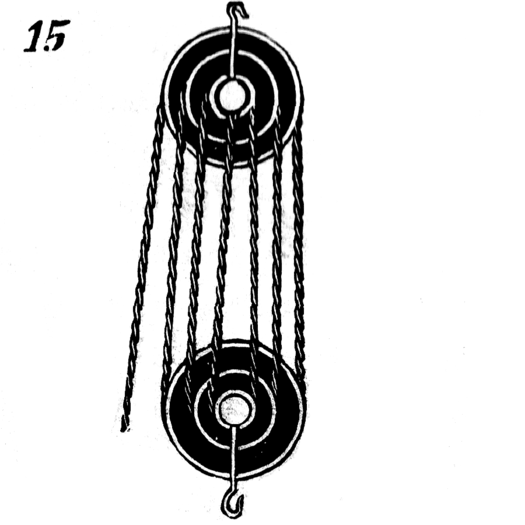
15. Represents what are known as White's pulleys, which can either be made with separate loose pulleys, or a series of grooves can be cut in a solid block, the diameters being made in proportion to the speed of the rope; that is, 1, 3, and 5 for one block, and 2, 4, and 6 for the other. Power as 1 to 7.