Movement No. 14 presents the classic Block and Tackle — one of the oldest, most practical, and most widely used compound pulley systems in human history. A block and tackle consists of two sets of pulleys: an upper fixed block, anchored to a stationary overhead support, and a lower movable block, attached directly to the load being lifted. A single continuous rope threads back and forth between the sheaves of both blocks in sequence, with one end anchored to the fixed block and the free end available for the operator to apply effort. The genius of this arrangement lies in its elegant simplicity and the straightforward rule for calculating mechanical advantage provided by Henry T. Brown: divide the weight of the load by double the number of pulleys in the lower movable block. This means that if the lower block contains 3 pulleys, the required effort force is the load divided by 6 — a mechanical advantage of 6:1. Every additional pulley added to the lower block adds two more rope segments supporting the load, further dividing the required effort force. The trade-off remains constant: the effort rope must be pulled through a distance proportional to the mechanical advantage gained. With its ability to lift enormous loads with modest applied force, the block and tackle has been indispensable across centuries of human endeavor — from ancient Egyptian construction of pyramids and Greek shipbuilding, to medieval siege engines, sailing ship rigging, and modern industrial cranes and rescue systems.
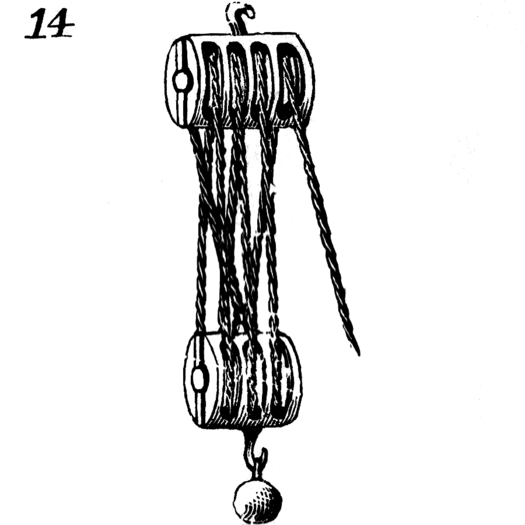
14. Blocks and tackle. The power obtained by this contrivance is calculated as follows: Divide the weight by double the number of pulleys in the lower block; the quotient is the power required to balance the weight.