Movement No. 11 presents an elegant and compact solution to the classic engineering challenge of transmitting rotational power between two shafts oriented at right angles to one another — and does so without the use of any guide pulleys. This movement is directly related to Movement No. 3, which achieves the same right-angle belt transmission but requires guide pulleys to keep the belt properly aligned and tensioned as it transitions between the two perpendicular shaft planes. Movement No. 11 eliminates this requirement entirely by exploiting the natural geometry of the belt itself: the two pulleys are positioned and oriented at precise angles relative to each other so that a flat belt can travel from one pulley to the other in a smooth, self-guided quarter-turn twist — transitioning the plane of the belt by 90 degrees without any intermediate guiding or tensioning devices. This works because the belt naturally tends to track toward the highest point of any crowned or angled pulley surface it contacts, and when the pulleys are carefully positioned so that the departing side of each pulley aims directly at the center plane of the receiving pulley, the belt maintains stable tracking through the quarter-turn transition entirely on its own. The result is a mechanically simpler, more compact, and lower-maintenance drive system compared to guide-pulley arrangements, making it particularly attractive in applications where space is limited or simplicity of construction is a priority. This principle continues to be applied in modern flat-belt and serpentine-belt power transmission systems.
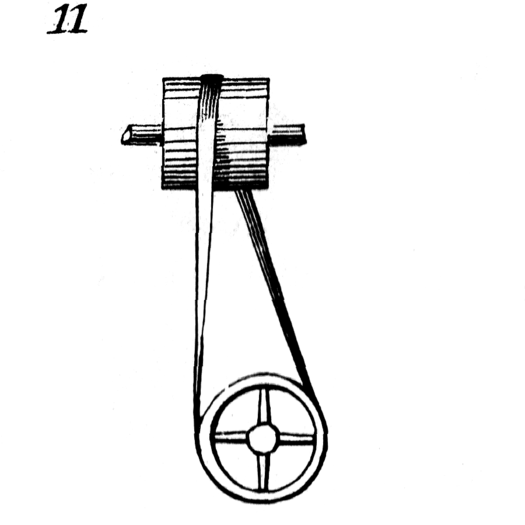
11. Another method of effecting the same result as 3, without guide-pulleys.