Movement No. 8 presents the Variable Speed Stepped Pulley — one of the most widely used and practically important speed-control mechanisms in the history of machine tool design. The stepped pulley system consists of two matched pulley sets, each comprising multiple pulley stages of different diameters arranged in a staircase-like profile — hence the name “stepped pulleys.” The two sets are mounted on parallel shafts (typically the drive shaft and the machine spindle shaft), with their steps arranged in opposing order: where the driver pulley set has its largest step, the driven pulley set has its smallest, and vice versa. A single flat belt connects the two sets and can be manually shifted from one step to another, engaging a different pair of opposing diameters at each position. Each belt position produces a specific, fixed speed ratio determined by the diameter ratio of the engaged steps. With three steps on each pulley set, for example, three distinct output speeds are available — giving the machine operator the ability to select the most appropriate spindle speed for the material and cutting tool in use. Henry T. Brown specifically cites its application in lathes and other mechanical tools — a testament to the mechanism’s central importance during the Industrial Revolution, when precise speed selection was critical for turning wood, brass, iron, and steel to different finishes. Unlike the cone pulley of Movement No. 9, which allows the belt to be placed at any position along a continuous taper, the stepped pulley provides discrete, repeatable speed selections, making it simpler and more reliable for workshop environments. Stepped pulleys can still be found today in drill presses, bench lathes, and wood-turning equipment worldwide.
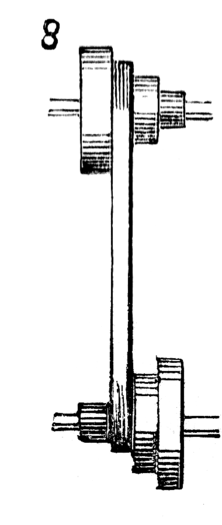
8. Speed-pulleys used for lathes and other mechanical tools, for varying the speed according to the work operated upon.