Movement No. 7 presents a brilliantly elegant mechanism for engaging, disengaging, and reversing an output shaft using nothing more than a shifting belt and a carefully arranged system of concentric shafts and bevel gears — with no friction clutch or complex reversing gearbox required. The mechanism operates through three distinct states controlled entirely by the lateral position of a single drive belt. At the heart of the system are two coaxial shafts: an outer hollow shaft, b, and an inner solid shaft, a, which runs concentrically inside it. Three pulleys sit side by side on the drive shaft — a left pulley fixed to the hollow shaft b (carrying bevel gear B), a center loose pulley that spins freely and transmits no motion, and a right pulley fixed to inner shaft a (connected to bevel gear A). When the belt rides on the center loose pulley, neither shaft turns — the system is disengaged and the output vertical shaft is stationary. When the belt is shifted left onto the pulley fixed to hollow shaft b, bevel gear B drives the upright output shaft in one direction. When the belt is shifted right onto the pulley fixed to inner shaft a, bevel gear A transmits drive to the upright shaft — but because shaft a and shaft b are concentric and their bevel gears mesh with the output shaft from different geometric arrangements, the direction of rotation of the output shaft is reversed. This gives the operator full three-state control — forward, neutral, and reverse — using only a belt shift lever. This mechanism was widely used in 19th-century machine tools, milling machines, and industrial equipment as a simple and reliable means of shaft direction control without stopping the prime mover.
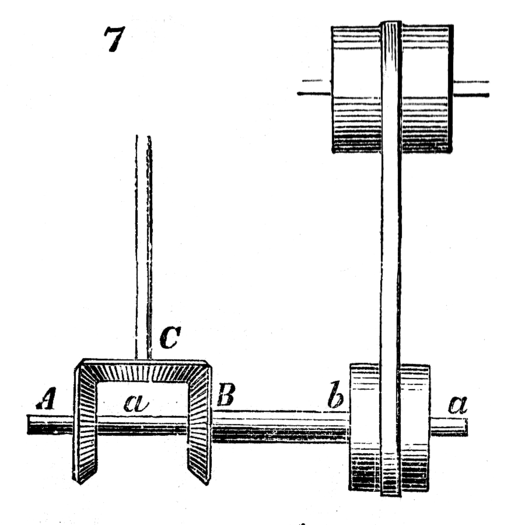
7. A method of engaging, disengaging, and reversing the upright shaft at the left. The belt is shown on the middle one of the three pulleys on the lower shafts, a, b, which pulley is loose, and consequently no movement is communicated to the said shafts. When the belt is traversed on the left-hand pulley, which is fast on the hollow shaft, b, carrying the bevel-gear, B, motion is communicated in one direction to the upright shaft; and on its being traversed on to the right-hand pulley, motion is transmitted through the gear, A, fast on the shaft, a, which runs inside of b, and the direction of the upright shaft is reversed.