Movement No. 6 presents a fascinating mechanism for converting a simple back-and-forth vibratory motion into a reciprocating rotary motion — transmitted through a belt and a semi-circular segment to a pair of pulleys below. The heart of the mechanism is a semi-circular segment, essentially a half-disk or curved rack, to which a lever is rigidly attached. When the lever is pushed and pulled back and forth in a vibratory oscillating motion, the semi-circular segment rocks correspondingly about its central pivot. A belt is fixed to and wrapped around the curved outer edge of this semi-circular segment, so that as the segment rocks in one direction, the belt is paid out on one side and taken up on the other — alternately pulling and releasing the pulleys below in a reciprocating fashion. The two lower pulleys are consequently driven in alternating directions of rotation — spinning clockwise, then counter-clockwise, then clockwise again — in perfect synchrony with each swing of the lever above. This mechanism elegantly bridges the worlds of linear oscillating input and rotary output, making it particularly useful in applications where a rocking or vibratory prime mover — such as a hand lever, a foot treadle, or a cam-driven rocker arm — needs to drive a rotating load. The semi-circular geometry of the segment ensures smooth, continuous belt engagement throughout the arc of the vibratory stroke, and the mechanism can be scaled easily to suit the amplitude and frequency requirements of different applications. This type of motion conversion is found historically in treadle-powered lathes, hand-operated sewing machines, and early reciprocating pumps.
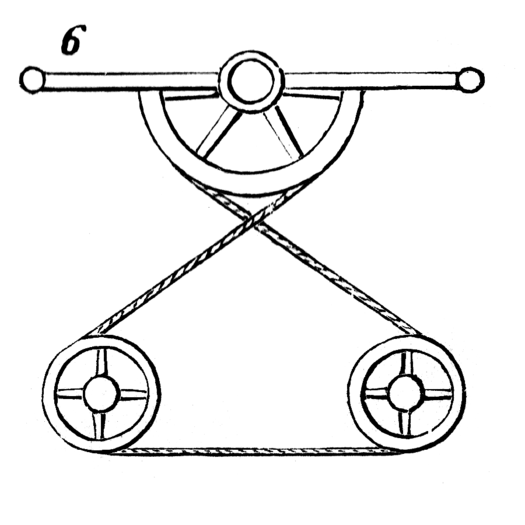
6. By giving a vibratory motion to the lever secured to the semi-circular segment, the belt attached to the said segment imparts a reciprocating rotary motion to the two pulleys below.