Movement No. 4 presents an elegant solution to a specific geometric challenge in belt transmission: how to transmit rotational motion between two shafts that are oriented at right angles to each other, but whose axes lie within the same plane. This distinguishes it from Movements No. 3 and No. 11, where the shafts are perpendicular and their axes lie in different planes — requiring the belt to twist out of plane as it transitions between the two pulleys. In Movement No. 4, because both shaft axes share the same plane, the belt can remain entirely within that plane throughout its path — but the two pulleys must be mounted at 90 degrees to each other, with one pulley’s axis perpendicular to the other’s within the common plane. Henry T. Brown presents two possible belt configurations for this arrangement: an open belt and a crossed belt. While an open belt can be used, the crossed belt is specifically recommended as the preferred solution because it provides a greater arc of contact — the angle over which the belt wraps around each pulley — thereby increasing the total friction force available for power transmission and reducing the likelihood of belt slippage under load. The crossing of the belt also naturally causes the driven pulley to rotate in the opposite direction to the driver, which may be advantageous or easily accommodated depending on the application. This mechanism provides a compact, gearless solution for changing the direction of a drive axis by 90 degrees within a single plane, and was widely used in mill machinery, agricultural equipment, and workshop tools where a simple direction change was needed without resorting to bevel gears or complex intermediate shafting.
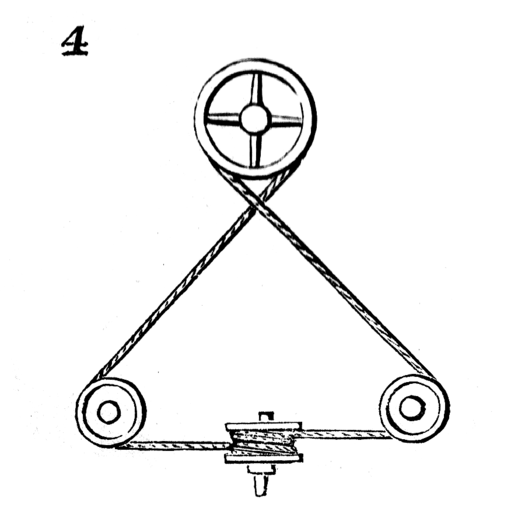
4. A method of transmitting motion from a shaft at right angles to another whose axis is in the same plane. This is shown with a crossed belt. An open belt may be used, but the crossed one is preferable, as it gives more surface of contact.