Movement No. 3 presents a classic engineering solution for transmitting rotational motion between two shafts oriented at right angles to each other — where the shaft axes do not lie in the same plane — using a pair of guide pulleys and a split belt. The central challenge of transmitting power between two perpendicular shafts via a belt is that the belt must transition from one plane of rotation to a completely different plane, rotating 90 degrees between the two pulleys. Without guidance, a flat belt attempting this transition would twist unevenly, run off the pulleys, and fail to transmit power reliably. Movement No. 3 solves this problem with an ingenious but simple solution: the drive belt is split into two separate leaves — essentially two narrow belts running side by side — and two guide pulleys are positioned at the transition point, mounted side by side on a common axle, one for each leaf of the belt. Each leaf of the split belt wraps around its own dedicated guide pulley, which redirects it smoothly and independently through the required 90-degree transition. By splitting the belt and providing individual guidance for each half, the mechanism ensures that the belt transitions cleanly and evenly between the two perpendicular shaft planes without twisting or running unevenly. The two guide pulleys work together as a pair to collectively redirect the full drive force of the belt system around the right angle. This mechanism is a direct mechanical precursor to the quarter-turn belt arrangement seen in No. 11, which achieves the same result without any guide pulleys by exploiting belt geometry alone — making the comparison between No. 3 and No. 11 a particularly instructive study in engineering design trade-offs between simplicity and reliability.
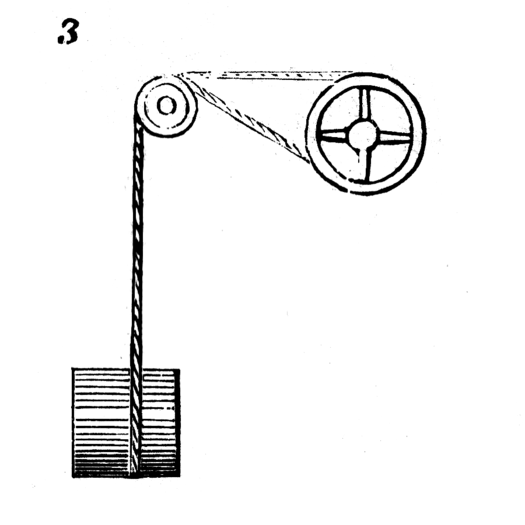
3. A method of transmitting motion from a shaft at right angles to another, by means of guide-pulleys. There are two of these pulleys, side by side, one for each leaf of the belt.