#077 Dual Pawl Ratchet Lever Near Continuous Rotation – 507 Mechanical Movements 3D Animation

#077 Dual Pawl Ratchet Lever Near Continuous Rotation – 507 Mechanical Movements 3D Animation

Monday, Apr 27, 2026

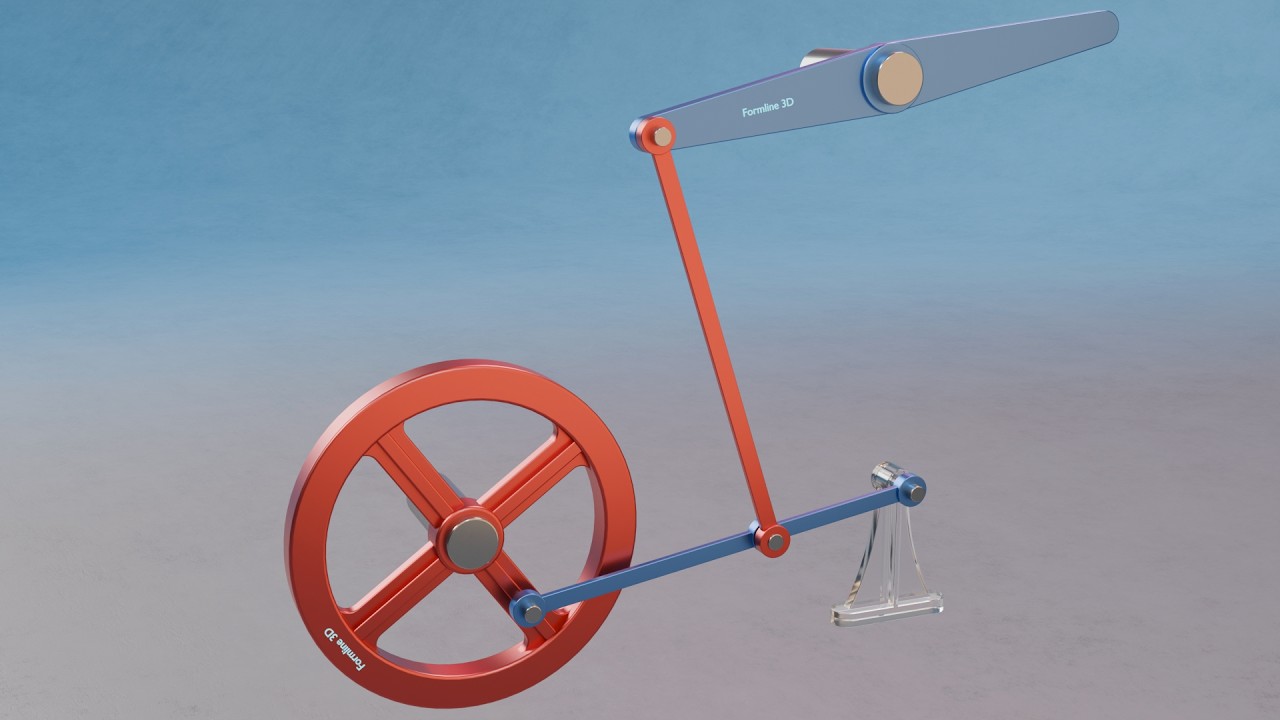
This animation demonstrates Movement No. 77 from “507 Mechanical Movements” — a dual-pawl ratchet mechanism in which a vibrating lever produces an almost continuous rotary motion. The lever C rocks back and forth about its fixed fulcrum A. Mounted on the lever are two pawls positioned to engage the teeth of the ratchet wheel B from opposite sides or at offset positions. The key feature of this mechanism is that the two pawls are arranged to act alternately — when the lever swings in one direction, the first pawl engages and advances the ratchet wheel by a set number of teeth; when the lever swings back in the other direction, the second pawl takes over and advances the wheel again by the same increment. Because both pawls drive the wheel in the same rotational direction on each half-stroke of the lever, the ratchet wheel B receives an advancing impulse on both the forward and return strokes. This means the wheel is driven twice per full oscillation of the lever, effectively doubling the frequency of advancement compared to a single-pawl arrangement and producing what the original text describes as “almost a continuous movement.” The slight intermittency that remains comes from the brief moment between one pawl disengaging and the next engaging. By carefully spacing the two pawls relative to the tooth pitch of the ratchet wheel, this dwell period can be minimized, resulting in a very smooth and near-continuous output rotation from an oscillating input. This mechanism was valued in applications where smoother output was needed from a reciprocating or oscillating input, such as in clockwork, weaving machinery, and mechanical calculating devices, where single-pawl ratchets produced too much jerkiness or too slow an output rate.

@
2 minute read
#076 Stud and Tappet Revolution Counter – 507 Mechanical Movements 3D Animation

#076 Stud and Tappet Revolution Counter – 507 Mechanical Movements 3D Animation

Sunday, Apr 26, 2026

This animation demonstrates Movement No. 76 from “507 Mechanical Movements” — a mechanical revolution counting mechanism driven by a stud, tappet, and ratchet wheel. The large driving wheel rotates continuously, carrying with it a single stud D fixed to its face. Mounted nearby on a fixed pivot C is the tappet B — a lever arm that is free to rock about its pivot point. One end of the tappet is positioned in the path of the rotating stud D, while the other end rests lightly against the teeth of the ratchet wheel A. Once per revolution of the large wheel, the stud D strikes the first end of the tappet B, causing it to rock on its pivot C. This rocking motion lifts the opposite end of the tappet upward, engaging a tooth of the ratchet wheel A and advancing it by exactly one tooth. The ratchet wheel therefore advances by one tooth increment for every complete revolution of the large driving wheel — making it a precise mechanical counter of revolutions. After the stud D passes and no longer presses against the tappet, the tappet returns to its original resting position under its own weight due to gravity. The end of the tappet that contacts the ratchet wheel is jointed — hinged — so that on the return stroke it can fold back and slide freely over the tops of the ratchet teeth without disturbing the wheel’s position. This jointed tip acts as a one-way driving pawl, ensuring motion is transmitted in one direction only. The simplicity and reliability of this mechanism made it highly suitable for use in mechanical counters, odometers, mill tallying devices, and industrial machinery where the number of rotations of a shaft needed to be recorded automatically and accurately without any external power source.

@
2 minute read
#075 Reciprocating Rod to Intermittent Rotation via Pawl – 507 Mechanical Movements 3D Animation

#075 Reciprocating Rod to Intermittent Rotation via Pawl – 507 Mechanical Movements 3D Animation

Saturday, Apr 25, 2026

This animation demonstrates Movement No. 75 from “507 Mechanical Movements” — a mechanism that converts reciprocating rectilinear motion into intermittent circular motion using a pawl and ratchet wheel. The driving rod C moves back and forth in a straight line. This reciprocating motion causes the vibrating bar D, which is connected to the rod, to swing alternately in two directions. At the end of the vibrating bar D sits the pawl B — a small pivoting catch shaped to engage the teeth of the ratchet wheel A. On the forward stroke of rod C, the vibrating bar D swings in one direction, and the pawl B catches a tooth of ratchet wheel A, pushing it forward by one or more teeth and advancing the wheel through a precise angular increment. On the return stroke, the bar D swings back, but the pawl B simply slides over the tops of the ratchet teeth without engaging them, allowing the wheel A to remain stationary. A separate stop-pawl or detent may also be used to prevent the wheel from back-driving during the return stroke. This cycle of advance and dwell repeats with every full stroke of the reciprocating rod C, producing a smooth and reliable intermittent rotation. The angular increment per stroke can be adjusted by changing the geometry of the pawl, the tooth pitch of the ratchet wheel, or the stroke length of the driving rod. The pawl-and-ratchet mechanism is one of the most fundamental and widely used mechanisms in mechanical engineering. It has been applied in clocks, textile looms, printing presses, feed mechanisms for machine tools, and countless other devices requiring controlled one-directional intermittent motion.

@
2 minute read
#074 Mutilated Bevel Gear Intermittent Reverse Motion – 507 Mechanical Movements 3D Animation

#074 Mutilated Bevel Gear Intermittent Reverse Motion – 507 Mechanical Movements 3D Animation

Friday, Apr 24, 2026

This animation demonstrates Movement No. 74 from “507 Mechanical Movements” — an intermittent alternating rotation mechanism driven by a mutilated bevel gear. At the heart of this mechanism is the mutilated bevel gear C — a bevel gear from which teeth have been removed over a portion of its circumference, leaving alternating toothed and toothless segments. As gear C rotates continuously on its drive shaft, its toothed segment sequentially engages bevel-gear A and bevel-gear B, which are mounted on perpendicular axes on opposite sides of gear C. When the toothed portion of C meshes with gear A, gear A is driven in one rotational direction. As rotation continues and the toothless segment of C reaches gear A, the engagement is broken and gear A comes to a complete stop — it dwells motionless while the blank section passes. As C continues to rotate, the toothed segment then engages gear B on the opposite side, driving it in the reverse rotational direction. When the toothless segment reaches gear B, it too comes to rest. This cycle repeats with every full revolution of the driving gear C, producing a perfectly uniform intermittent rotation that alternates between gears A and B in opposite directions. The dwell periods are determined by the angular extent of the toothless segments on gear C, which can be designed to provide longer or shorter pauses as required by the application. This type of mechanism was historically used in textile machinery, indexing tables, and automatic feed systems where two alternating outputs needed to be driven from a single power source with precise timing and no additional control components.

@
2 minute read

© 2026 Formline 3D Mechanisms

Powered by Formline 3D

Formline 3D

Formline 3D is a 3D animation channel exploring the form, structure, and design of the world around us.

From everyday objects to complex machines, we use Blender and real-time graphics to visualize how things are built, how they work, and how their shapes come together.

No talking heads. No stock footage. Just carefully crafted 3D animations that turn objects, technology, and ideas into clear visual stories.

If you love design, engineering, products, or simply understanding how things are made — you’re in the right place.