Video

56 articles

Video
#036 Mangle Wheel & Pinion – 507 Mechanical Movements 3D Animation

#036 Mangle Wheel & Pinion – 507 Mechanical Movements 3D Animation

Tuesday, Mar 10, 2026

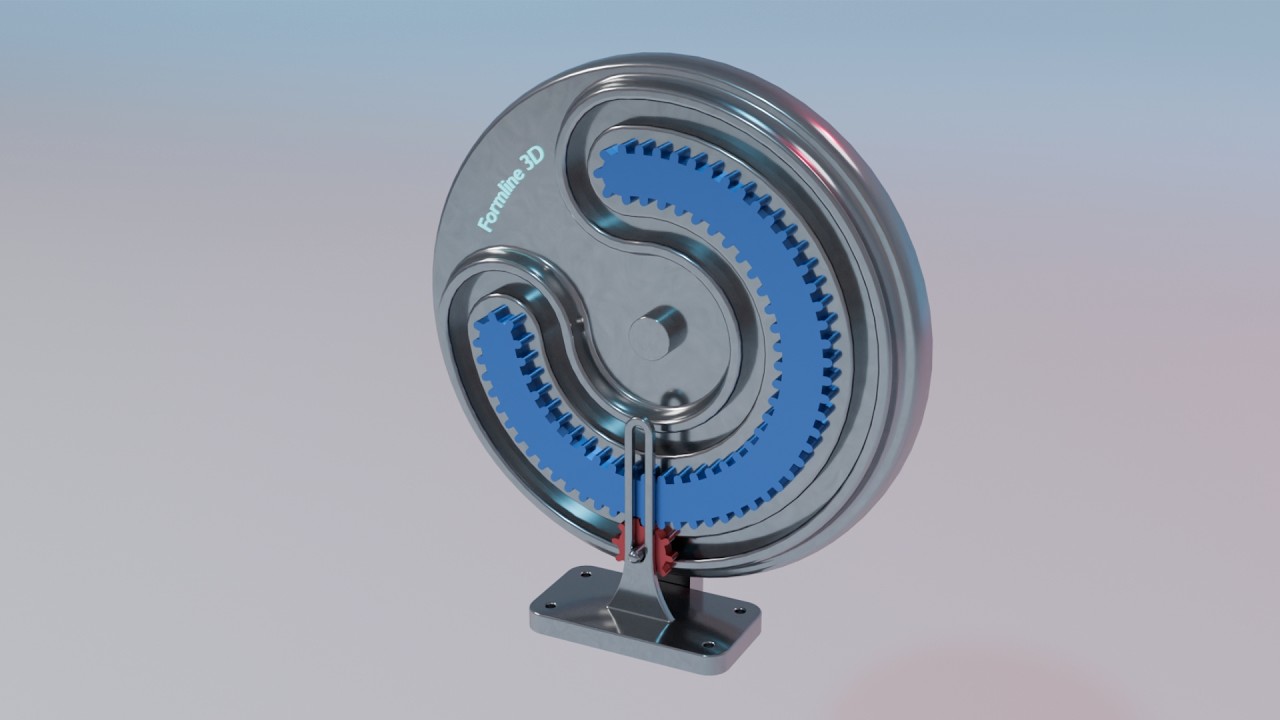
Movement No. 36 presents one of the most mechanically fascinating and historically distinctive gear mechanisms in the entire 507 collection — the Mangle Wheel and Pinion, named for its original application in cloth-pressing mangle machines. This mechanism performs a remarkable transformation: it converts the continuous unidirectional rotation of a small pinion into a reciprocating (back-and-forth) rotary motion of the large mangle wheel — without any reversal of the driving pinion’s rotation. The mangle wheel is a large disk-like gear with teeth arranged around its periphery on both the inside and outside of its rim, forming a continuous closed track of teeth. A slot is cut into the face of the mangle wheel following its outline, which serves to guide and constrain the pinion shaft. A small pinion meshes with these teeth and is carried on a shaft that slides vertically in a straight slot cut in a fixed stationary upright bar. As the pinion rotates continuously in one direction, it travels along the outer teeth of the mangle wheel — driving the wheel in one direction — until it reaches the end of the outer tooth track, at which point the guiding slot in the wheel face transitions the pinion shaft smoothly from the outside to the inside of the wheel’s tooth track. The pinion then travels back along the inner teeth, driving the mangle wheel in the opposite direction — all while the pinion itself continues rotating in the same direction without interruption. The pinion shaft rises and falls in the stationary bar’s slot to accommodate this transition between the inner and outer gear tracks. The result is a smooth, continuous reciprocating oscillation of the large wheel produced entirely by unidirectional pinion rotation — an elegant kinematic solution that was used in early laundry mangles, and whose principle appears in various intermittent and reciprocating drive applications throughout mechanical history.

@
2 minute read
#035 Variable Rotary Motion – Elliptical Gear – 507 Mechanical Movements 3D Animation

#035 Variable Rotary Motion – Elliptical Gear – 507 Mechanical Movements 3D Animation

Monday, Mar 9, 2026

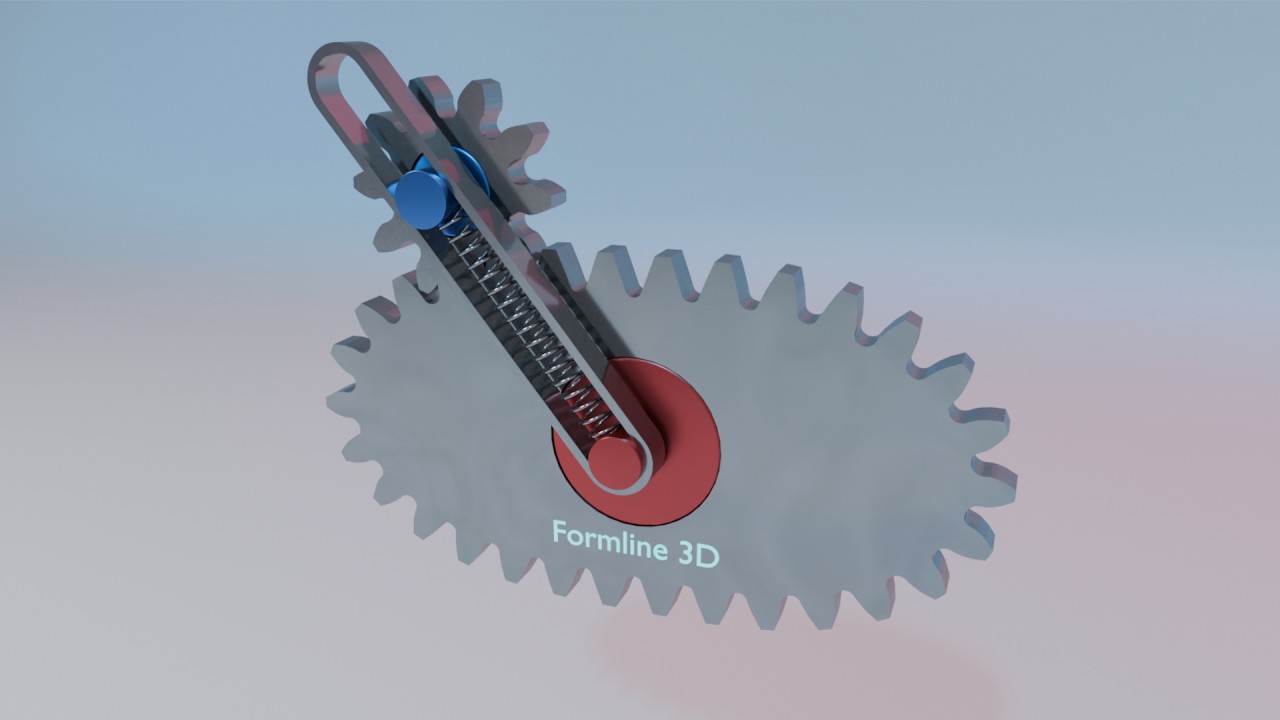
Movement No. 35 presents a highly inventive mechanism for converting uniform rotary input into variable rotary output — using an elliptical gear, a spring-loaded pinion, and a slotted bar in a clever compound arrangement. At the heart of the system is an elliptical gear, whose radius continuously changes as it rotates — being longer along the major axis and shorter along the minor axis. A slotted bar is pivotally mounted so that it turns loosely on the shaft of this elliptical gear, meaning it is centered on the same axis but is free to rotate independently. A small spur pinion is mounted at the end of this bar and meshes with the teeth of the elliptical gear. As the elliptical gear rotates, its varying radius causes the contact point between the pinion and the elliptical gear to move closer and farther from the central shaft. The slot cut into the bar accommodates precisely this variation — the pinion’s bearing slides along the slot to follow the continuously changing radius of the elliptical gear surface, ensuring that the pinion always remains properly engaged with the gear teeth regardless of the current radius. A spring applied to the pinion’s bearing keeps it pressed firmly against the elliptical gear at all times, maintaining positive tooth engagement through the full rotation cycle. Because the pinion is walking along the profile of the elliptical gear, the bar carrying the pinion is driven at a continuously varying angular velocity — fast when the pinion contacts the shorter minor-axis region of the ellipse, and slow when it traverses the longer major-axis region. This produces a smoothly varying, cyclically repeating output rotation from a perfectly uniform input — a motion profile highly useful in machinery requiring periodic speed variation.

@
2 minute read
#034 Internal Ring Gear & Pinion – 507 Mechanical Movements 3D Animation

#034 Internal Ring Gear & Pinion – 507 Mechanical Movements 3D Animation

Thursday, Feb 26, 2026

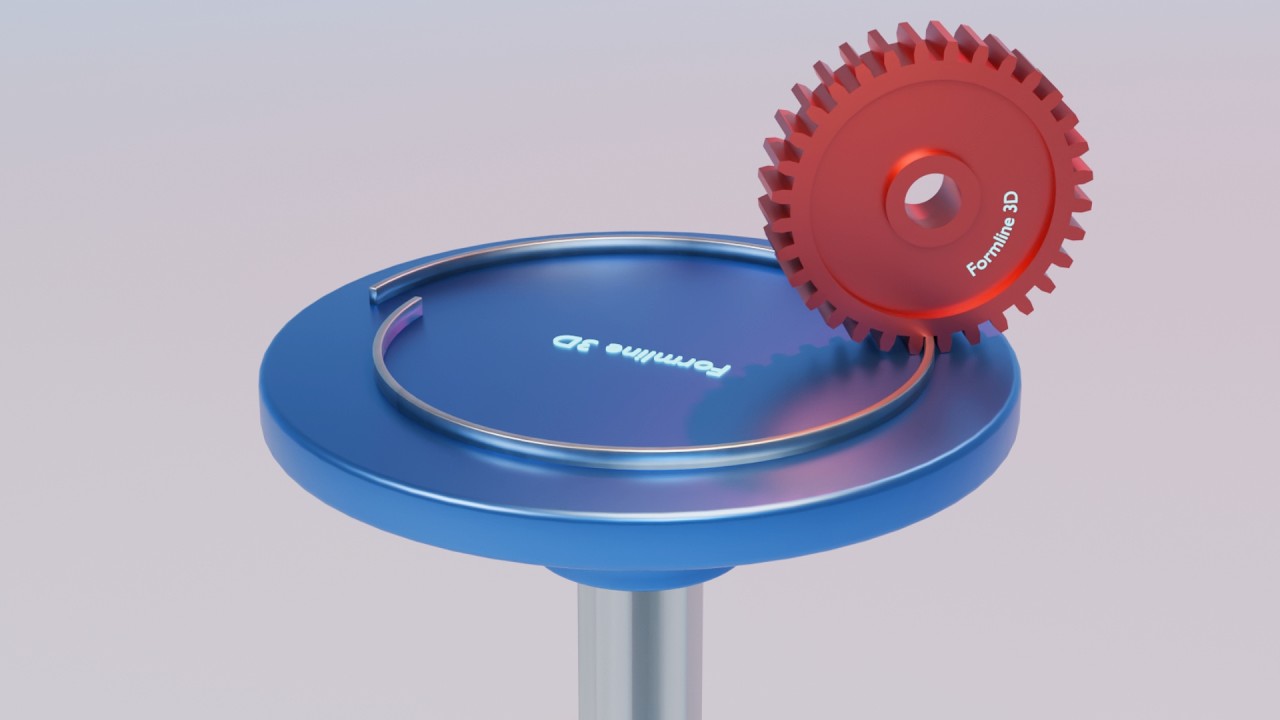
Movement No. 34 introduces the internally toothed spur gear — also known as the ring gear or annular gear — paired with a smaller pinion gear that meshes on its inside surface. This is a direct and illuminating contrast to Movement No. 24, which presented the conventional external spur gear pair. In an external gear pair (No. 24), the teeth of two gears face outward from each other, and the two gears necessarily rotate in opposite directions. In Movement No. 34, the teeth of the larger gear face inward — pointing toward the center of the ring — and the smaller pinion meshes inside the ring, running along the internal tooth surface. This internal engagement produces two immediately important differences from the external configuration. First, both the ring gear and the pinion rotate in the same direction — unlike external gears where the driver and driven always turn opposite to each other. This same-direction rotation is highly valuable in compact transmission designs where preserving the sense of rotation through a gear stage is important. Second, and critically from a strength and reliability standpoint, more teeth are simultaneously in contact between the pinion and the internal ring than would be the case in an equivalent external gear mesh — meaning for the same tooth strength, the internal gear pair can transmit significantly greater force without tooth failure. The internal ring gear and pinion is a foundational component of planetary gear systems, automatic transmissions, epicyclic gear trains, and many compact, high-torque drive systems used in modern automotive, aerospace, and industrial applications.

@
2 minute read

© 2026 Formline 3D Mechanisms

Powered by Formline 3D

Formline 3D

Formline 3D is a 3D animation channel exploring the form, structure, and design of the world around us.

From everyday objects to complex machines, we use Blender and real-time graphics to visualize how things are built, how they work, and how their shapes come together.

No talking heads. No stock footage. Just carefully crafted 3D animations that turn objects, technology, and ideas into clear visual stories.

If you love design, engineering, products, or simply understanding how things are made — you’re in the right place.